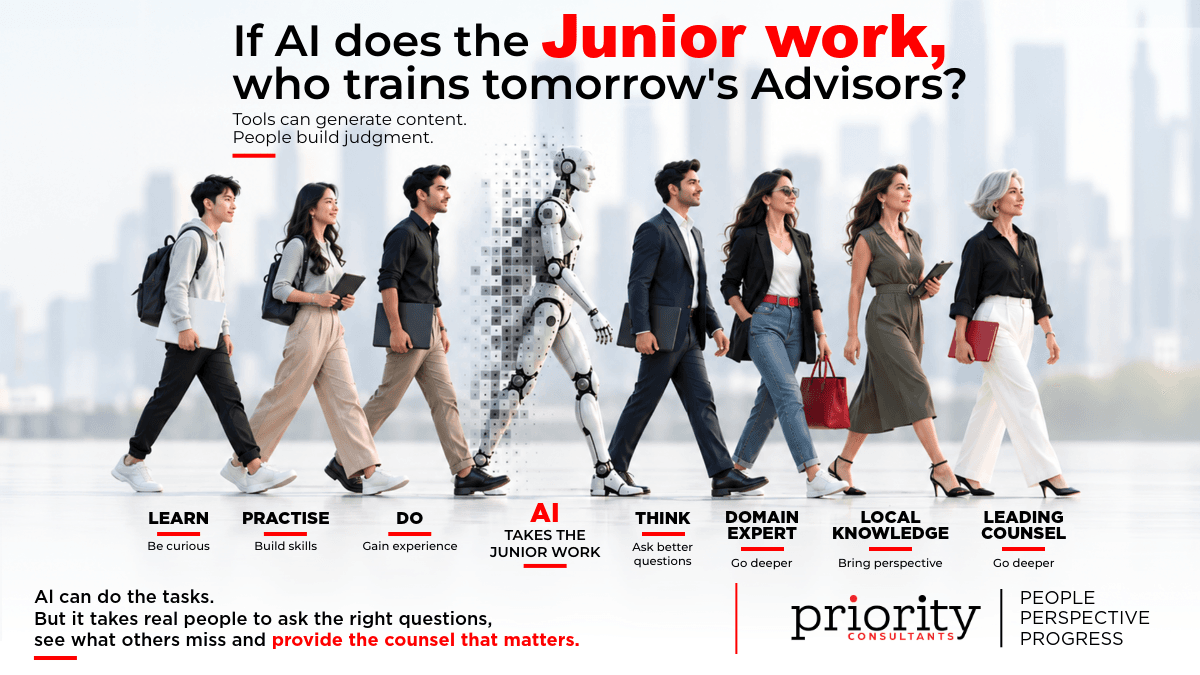
What happens when the fastest way to do the work is no longer the best way to learn it. Artificial intelligence (AI) is already changing the apprenticeship model in PR and communications.
Research that once took a junior half a day can now take minutes. First drafts can be generated instantly. Coverage can be summarised and information synthesised at a speed no entry-level professional can match.
That is undoubtedly progress, but if AI does the work through which people traditionally learned, how do we develop the next generation of senior advisers?
In our industry, people learn by doing. They write the first draft, build the media list, prepare the briefing, and sometimes get things wrong. They receive feedback, try again, and gradually develop an understanding of what “good” looks like.
But they are also learning something less tangible. How to listen. How to ask a better question. How to understand what a client is really worried about, rather than simply what they have asked for. These are the foundations of an adviser.
The same applies to relationships. If clients don’t trust you enough to share the real problem, you are unlikely to win the job. Building that trust means knowing the customer as a person. Understanding their pressures, ambitions, and personalities. Knowing what they need before they ask.
Technology has made relationships easier to manage at scale, but potentially easier to flatten too. CRM systems turned relationships into data points. AI can take that further.
But does AI really listen? Can it pick up the hesitation behind an answer, understand a change in tone, or recognise that the problem a client has described isn’t quite the problem they are actually trying to solve?
Perhaps eventually. But these are precisely the capabilities we need people to develop now.
Knowing about someone isn’t the same as knowing them. Sure, AI can analyse vast amounts of information about a person, organisation or audience. It can tell us what someone has said, written, shared and engaged with. It has changed the economics of knowing.
But logging publicly available information about a journalist into a media database is not the same as genuinely understanding that person’s interests, priorities, and preferences.
Our recent experience with Xavier reinforced our belief that people need meaningful responsibility early. They need to do the work, make mistakes, receive feedback, and gradually take on more complex decisions.
AI doesn’t change that philosophy. We see it as something to give juniors more opportunities to do the things that machines struggle with, such as making judgement calls or building relationships with customers and media personnel. Because if AI is going to carry more of the technical load, then communications people everywhere need to get better at being what AI can never be — human.