It’s Complicated! In the personal world, it means “don’t ask,” and in the business context, it’s usually a problem to be solved with some associated empire building. After all, if it’s complicated and I know what, how, and why, then I am King or Queen in that particular domain.
In Asia, complexity is not something to run away from. It is something to understand, navigate, and make work.
To those unfamiliar with the region, decision-making can seem slow. Consensus-building may look cumbersome and anyone doing business in Japan knows just what that means. Market structures can appear fragmented and inefficient.
Yet Asia does not merely function despite complexity. In many cases, it thrives because of it.
This is not unique to boardrooms; it is visible in everyday systems that outsiders often underestimate.
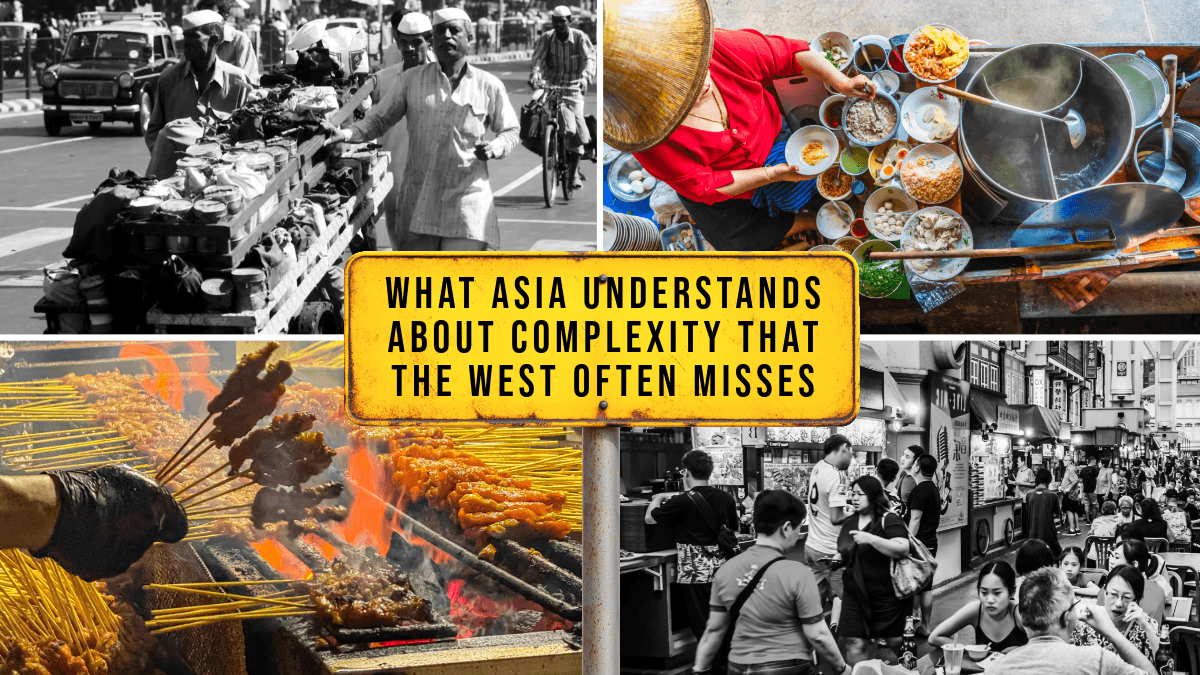
Take India’s Dabbawallas. Every day, Mumbai’s lunchbox delivery network moves thousands of meals across one of the world’s most densely populated cities with remarkable precision. The system is not powered by advanced technology or rigid central control but it works because of deep local knowledge.
Similarly, Southeast Asia’s hawker centres may look chaotic to an outsider: independent stallholders, dense foot traffic, shifting customer patterns, multilingual exchanges, and unwritten rules about space. Yet these centres feed cities, support livelihoods, preserve culture, and respond quickly to changes in demand.
Both examples show that complexity is not always a problem to be simplified. When properly understood, it can be organised and highly effective, and Asia understands this because it was forged in diversity.
The assumption that systems must become simpler to become more effective is not universally valid. In diverse environments, especially, attempts to impose uniformity can create friction rather than efficiency.
To external observers, the emphasis on consensus can be mistaken for indecision, a preference for gradual progress can be misread as a lack of urgency, and nuanced stakeholder environments can be seen as an obstacle to action.
These characterisations minimise the need for flexibility and continuity, which the world today increasingly shows are critical characteristics.
Asian markets are also not a monolith, and every system has its own unique characteristics, but the region’s underlying strength lies in a pragmatic give-and-take approach.
Too many market entry plans treat Asia as a single market. They assume messages, stakeholder expectations, media narratives, and policy concerns will travel easily across borders. In reality, what works in Singapore may not work in Indonesia, Vietnam, Thailand, Malaysia, or the Philippines.
National institutions, cultural expectations, and industry relationships all differ across those markets, and understanding those layers can’t be achieved through desk research. It requires local market knowledge on how trust is built, how influence moves, how media narratives form, how government and industry stakeholders engage, and how reputation is earned or lost.
In a world increasingly defined by volatility, systems that absorb variation may prove more durable than those designed only for uniformity. The lesson is not that complexity should be embraced for its own sake but that complexity, when properly understood and managed, can become a source of stability.
For organisations expanding across Asia, local knowledge is not a supporting detail. It is the advantage that allows strategy, communications, and reputation to work across markets that are connected, but never identical.